 Helpful resources and insights
Practical advice, thoughtfully presented.
Guides and product information from the original Aquavolt Articles page.
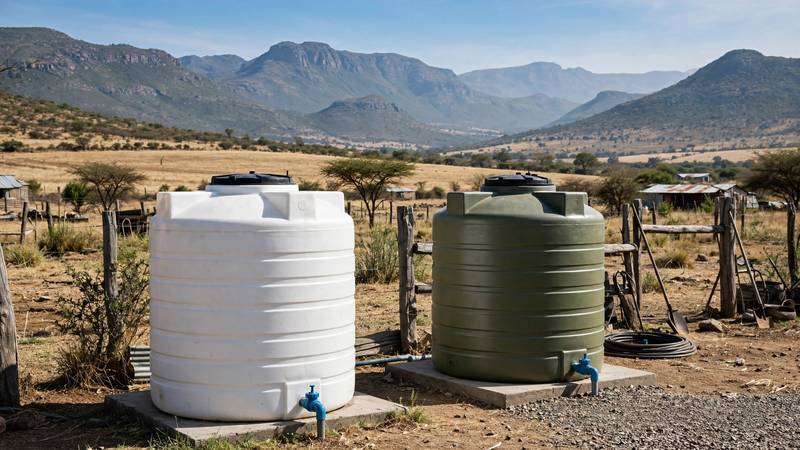
How to Choose the Right Water Tank Size for Your Farm or Home
Water security is no longer optional in South Africa. Whether you are supplying a family home, a smallholding, or a full-scale farming operation, choosing the right water tank size is one of the most important investments you will make. Too small and you run dry during municipal interruptions. Too large and you tie up unnecessary capital and space.
At Aquavolt, we manufacture rotationally moulded polyethylene tanks from 250 litres up to 20,000 litres, designed specifically for harsh African conditions. But how do you calculate what you actually need?
Start with daily consumption. A typical South African household uses 200 to 300 litres per person per day for drinking, cooking, bathing and laundry. A family of four therefore needs 800 to 1,200 litres daily. For emergency municipal backup, we recommend a minimum of three days storage – that puts you in the 2,500 to 5,000 litre range for a standard home. If you have a garden or pool top-up, add 30% more.
For farms, the calculation changes. Livestock is a major factor: cattle drink 40 to 80 litres per day, sheep around 5 to 10 litres. Irrigation needs depend on crop type and hectares, but a good rule of thumb is 10,000 litres per hectare per day in summer for vegetables. Many of our farming clients combine multiple 10,000-litre tanks rather than one massive tank – this provides redundancy and easier pressure management.
Also consider your refill rate. If you rely on rainwater harvesting, look at your average annual rainfall and roof catchment area. A 100m² roof in Gauteng can harvest around 60,000 litres per year. If you have municipal fill, a smaller tank with automatic top-up may be sufficient. If you are off-grid with borehole water, larger storage protects your pump from short-cycling.
All Aquavolt water tanks are UV-stabilised, BPA-free, and come with a 10-year warranty. They are available in vertical, horizontal and slimline profiles to fit tight urban yards or open farmland. Our team can help you size correctly the first time, so you do not pay twice.
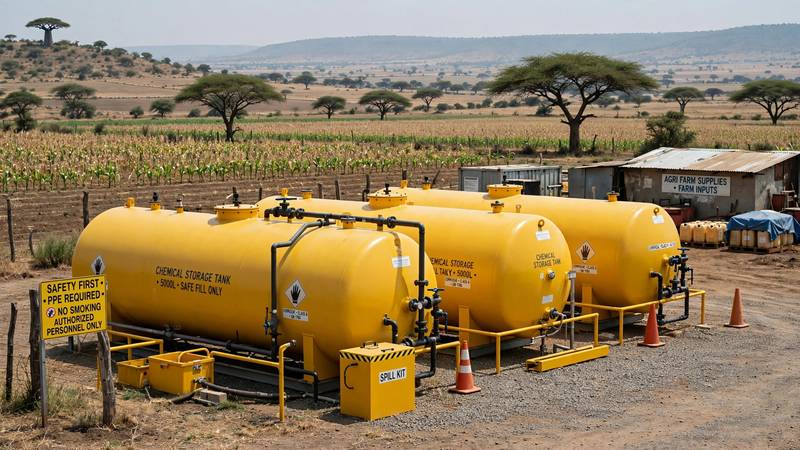
Chemical Storage Tanks: Safe and Compliant Solutions for Agriculture and Industry
Fertilisers, herbicides, diesel, and liquid feeds are essential to modern farming, but storing them incorrectly creates serious safety, environmental and legal risks. A standard water tank is not designed for chemicals. You need a tank engineered for chemical resistance, stability and containment.
Aquavolt chemical tanks are manufactured from chemical-grade linear low-density polyethylene with enhanced wall thickness and UV stabilisers. Our signature yellow colour is not cosmetic – it is an industry identifier for chemical containment and improves visibility for safety audits.
The first consideration is compatibility. Different chemicals attack different materials. Our polyethylene range is suitable for a wide range of agricultural chemicals including UAN, liquid fertilisers, molasses, and many herbicides and pesticides at recommended dilutions. For highly corrosive substances, we recommend double-checking the chemical compatibility chart and using our heavy-duty industrial range with thicker walls.
Second is safe placement. South African regulations require chemical tanks to be placed on a level, bunded area capable of containing 110% of the tank volume. Keep tanks away from waterways, boreholes and dwellings, and ensure secondary containment. All Aquavolt chemical tanks feature moulded-in lifting lugs, calibrated level indicators, and 400mm screw lids for safe inspection without entering the tank.
Venting is critical. Chemical tanks must be vented correctly to prevent vacuum collapse or pressure build-up, especially in our high-temperature climate. We fit all chemical tanks with chemical-resistant breather vents and can supply bunds, stands and spill kits as part of a complete solution.
Farmers across Limpopo, Free State and the Western Cape trust Aquavolt for seasonal fertiliser storage because our tanks do not corrode, do not require painting, and maintain integrity for over 15 years. Whether you need 1,000 litres for a spray program or 20,000 litres for bulk fertiliser, we deliver directly to your farm.
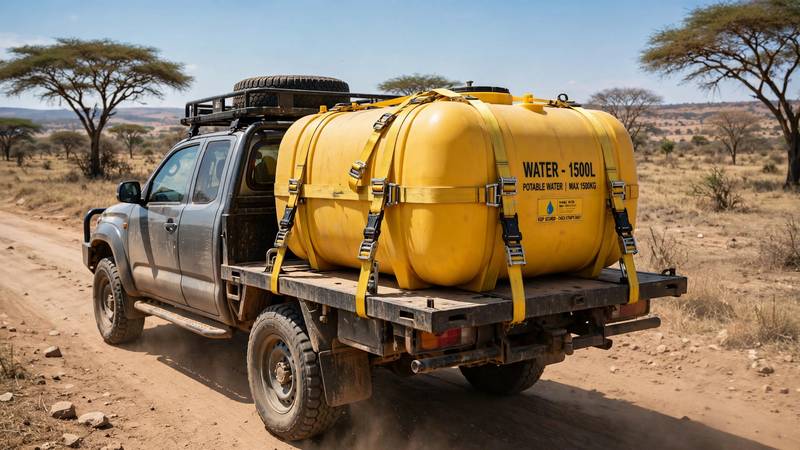
Vertical vs Horizontal Water Tanks: Which Design is Right for You?
When most people picture a water tank, they think tall and round. But at Aquavolt, nearly 40% of our sales are horizontal and low-profile tanks. The shape you choose affects footprint, water pressure, transport, installation cost and even water quality.
Vertical water tanks are the most efficient use of space and money. Because of their cylindrical design, they have the best strength-to-weight ratio, which means we can manufacture them with optimal wall thickness at a lower price per litre. They also deliver better natural water pressure due to height. If you have open space on a farm, smallholding or large suburban stand, a vertical tank from 5,000 to 20,000 litres is almost always the most economical choice. They are also easier to clean, as sediment concentrates at the bottom outlet.
Horizontal tanks, often called transport tanks or low-profile tanks, are designed for different challenges. Their low centre of gravity makes them ideal for trailer mounting, bakkie transport and areas with height restrictions. If you need to move water between camps for livestock, a 1,000 or 2,000-litre horizontal tank on a frame is far safer than a vertical tank on the back of a bakkie.
For urban homes where space is tight, our horizontal and slimline vertical tanks can fit along a side wall, under a carport, or even in a basement parking area. A 2,500-litre horizontal tank is only 1.2 metres high but provides three days of backup for a small family. This is why townhouse complexes and lodges in Cape Town and Johannesburg prefer them.
Strength is another factor. All Aquavolt tanks, regardless of shape, are one-piece rotationally moulded with no seams to fail. However, horizontal tanks require a full cradle or flat concrete slab support along their entire length, while vertical tanks only need a level, compacted base slightly larger than the tank diameter. Skipping this step voids warranties across the industry.
In short: choose vertical if you want maximum litres for minimum cost and best pressure. Choose horizontal if you need to transport water, have low height clearance, or need to distribute weight over a larger area. Not sure? Send us a photo of your space and we will recommend the right footprint.
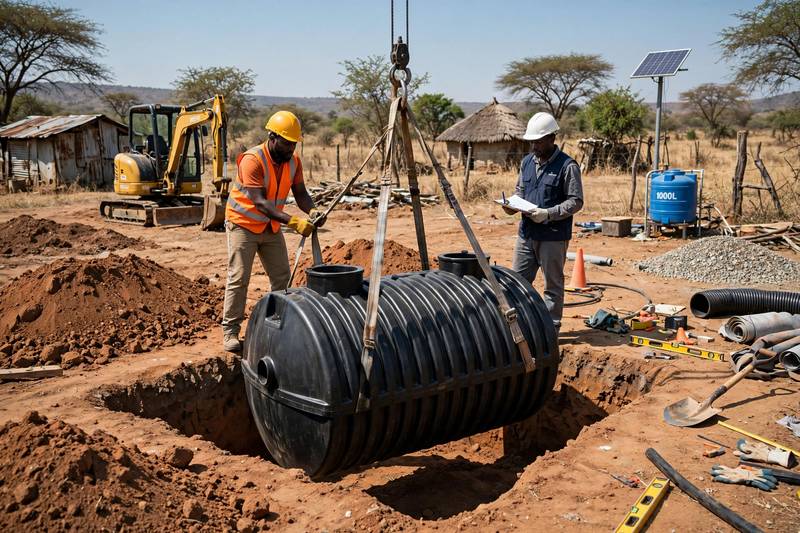
Septic Tank Installation: A Practical Guide for South African Homes
More than 3 million South African households are not connected to municipal sewer. For farms, lodges, new estates and rural homes, a properly installed septic system is not a compromise – it is a safe, long-term sanitation solution when done correctly.
A septic system has two parts: the septic tank itself, where solids settle and anaerobic bacteria break down waste, and the French drain or soakaway, where clarified effluent is safely dispersed into the soil. Aquavolt manufactures two-chamber septic tanks from 1,500 to 5,000 litres using heavy-duty polyethylene that will never rust, crack or corrode like concrete.
Sizing is straightforward. South African SANS 10400 recommends 1,500 litres for a two-bedroom home, 2,500 litres for three to four bedrooms, and 3,500 litres plus for five bedrooms or homes with high water usage. Always size for the number of people who could live in the house, not just current occupancy. Undersized tanks lead to premature soakaway failure, which is expensive to repair.
Installation must be done right. Excavate 500mm wider than the tank on all sides, bed the tank on 100mm of river sand, and backfill with sand – never with excavated rocks or building rubble, which can puncture the tank over time. The tank must be installed level, with inlet 50mm higher than outlet, and vented through the house plumbing. Keep heavy vehicles off the area unless you use a concrete traffic lid, which we supply.
Soil type matters. Sandy soils drain well and need shorter French drains. Clay soils require longer drains or a conservancy tank system. In high water table areas, our low-profile septic tanks with additional ballast are recommended. We always advise a percolation test before final design – our technical team provides free layout guidance if you send us your site plan.
Maintenance is minimal but important. Have your Aquavolt septic tank desludged every 3 to 5 years, avoid flushing wipes, sanitary products and harsh chemicals that kill beneficial bacteria, and divert greywater where possible. A well-maintained polyethylene septic tank will last 30 years or more.
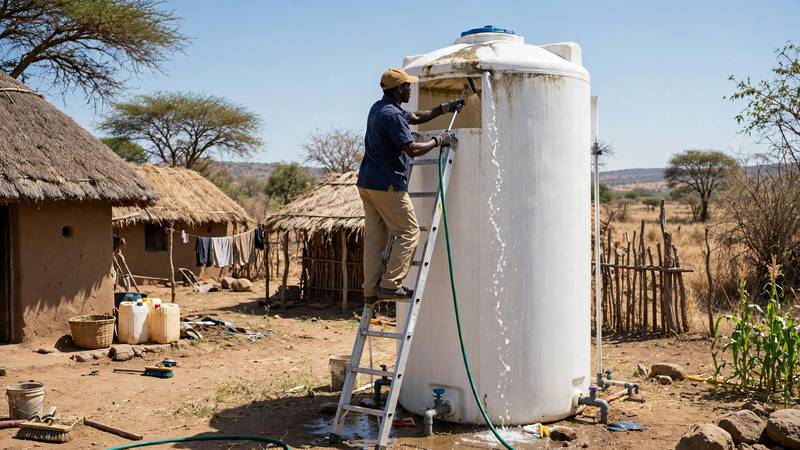
Water Tank Cleaning and Maintenance: How to Keep Your Water Safe
You invested in a quality water tank, but when last did you look inside it? In South Africa’s hot climate, algae, biofilm and sediment can build up quickly, affecting taste, smell and safety. Cleaning your tank at least once a year is essential, whether it stores municipal backup or harvested rainwater.
The signs are easy to spot. If water has an earthy smell, leaves a slimy feel on your hands, or your filters clog faster than usual, your tank needs attention. Even without signs, we recommend a full clean every 6 to 12 months for drinking water tanks, and every 12 to 18 months for irrigation or non-potable use.
Cleaning is straightforward but must be done safely. First, isolate the tank from the mains and use up as much water as possible for garden or non-potable use – never waste it. Enter the tank only if it is large enough and you have a spotter outside; for most domestic tanks under 5,000 litres, cleaning from the outside with a long-handled brush is safer. Scrub the walls and floor with a non-toxic, food-grade tank cleaner or a mild bleach solution (50ml per 1,000 litres), then rinse thoroughly. Aquavolt tanks have a wide 400mm lid and smooth internal surface specifically to make this easier.
Prevention is better than cure. Always keep your tank sealed and covered – sunlight is the number one cause of algae. Install a first-flush diverter on your rainwater system to prevent roof dust, bird droppings and leaves from entering. Use a leaf strainer at the gutter and a fine mesh filter at the tank inlet. If you store water for more than a month, consider a certified water stabiliser.
Inspect fittings quarterly. Check your ball valve, overflow screen, and outlet tap for leaks or insect entry. Ensure your tank stand or base has not shifted, cracked or eroded after heavy rains. A small leak at the outlet can undermine a concrete base over time. All Aquavolt accessories are UV-resistant, but seals should be replaced every 3 to 5 years.
Clean water starts with a clean tank. Our polyethylene tanks do not leach, do not rust, and are approved for potable water storage. If your tank is older or difficult to access, we offer trade-in options and can help you upgrade to a new Aquavolt system with improved access and filtration.